
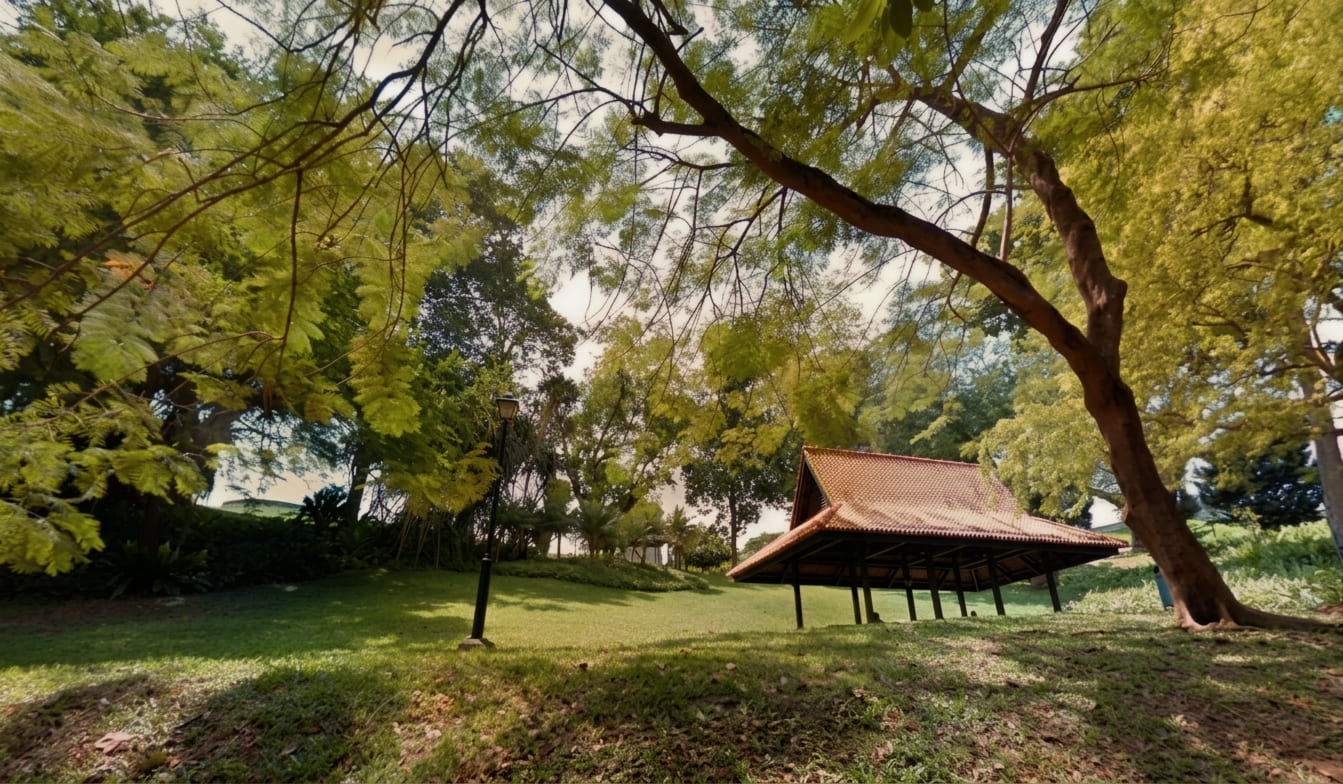
The Keramat Sultan Iskandar Shah on Fort Canning Hill, 2026
Fort Canning Hill was known as Bukit Larangan, or Forbidden Hill, long before it became a British fort. Malay rulers were traditionally associated with the hill, and it was later used for a residence, a fort, a reservoir and a military bunker.
Fort Canning Arts Centre in Fort Canning Hall, 2026
Why is Fort Canning called the Forbidden Hill?
Before it was called Fort Canning, the hill was known as Bukit Larangan, the Forbidden Hill.
Malay tradition holds that kings lived and were buried on the hill in the fourteenth century. Commoners were not allowed to enter the area. One explanation for the restriction was a spring on the hill that was reserved for the women of the royal household.The name survived long after the Malay kingdom had disappeared.
Tank Road, at the foot of the hill, has a different connection with water. It takes its name from a reservoir that was later built there.
Bukit Larangan, meaning “Forbidden Hill” in Malay, is the historical name for Fort Canning Hill in Singapore, 2026
Who were the kings of Bukit Larangan?
The identity of the rulers associated with the hill is difficult to establish from surviving records.
The story of Malay kings living and being buried on the hill appears in oral tradition and early Malay chronicles, but there is no complete documented royal line that can be connected securely to the site.
The name Bukit Larangan remained in use, however, and the hill continued to be associated with royalty for centuries.
What did archaeologists find on Fort Canning Hill?
In 1984, an excavation led by archaeologist John Miksic uncovered pottery, coins, glass and evidence of gold working on the hill. The material dated to the fourteenth century.
The finds provided archaeological evidence for a settlement on the hill during the period traditionally associated with the kingdom of Singapura. They also showed that people living there were involved in activities such as gold working and trade.
Whose tomb is the keramat on Fort Canning?
On the hill is a shrine known as Keramat Iskandar Shah.
It is traditionally identified as the tomb of Iskandar Shah, who is regarded in Malay tradition as the last ruler of Singapura before the royal court moved to Melaka.
The identification is disputed. Historical accounts place Iskandar Shah’s death in Melaka rather than Singapore.
The shrine was already known to visitors in the nineteenth century. In 1822, British Resident John Crawfurd recorded it and noted that it was visited by both Muslims and Hindus.
The shrine remains one of the places on the hill associated with the earlier Malay settlement.
The Keramat Sultan Iskandar Shah on Fort Canning Hill, 2026
What is left of the fort today?
Stamford Raffles built a residence on Fort Canning Hill in the 1820s. A fort was constructed later in the 1860s. A reservoir was added in the 1920s.
The fort itself has largely disappeared. Its Gothic gates survive at the base of the hill and are among the early examples of Gothic Revival architecture in Singapore.
There was also a Christian burial ground on the hill. It was later cleared, and the remains were exhumed. Some of the tombstones were reused in the boundary walls.
Among those buried there was Esther Farquhar Bernard, the daughter of William Farquhar, Singapore’s first British Resident. She died in 1838.
Of the fort’s three sally ports, which allowed soldiers to leave and re-enter the fort without using the main gate, one survives.
What happened in the Battle Box in 1942?
A military bunker was built beneath Fort Canning Hill between 1936 and 1938.
Known as the Battle Box, it contained around thirty rooms and was used as the headquarters of the Malaya Command during the Second World War.
In February 1942, British commanders met there as Japanese forces advanced on Singapore. The decision to surrender was made in the bunker on 15 February.
Fort Canning Bunker (The Battlebox), 2004. Credits: The Collections of the National Library Singapore
The bunker is about four hundred metres from the corner shophouses on River Valley Road.
Fort Canning Hill therefore contains several different periods of Singapore’s history within a relatively small area. The Malay royal settlement came first, followed by the British residence and fort, and later the military installations beneath the hill.
A few minutes further along, at the former railway terminus on Tank Road, another part of the area’s history begins. The story continues in the next chapter, The Iron Pulse, part of The Crossroads of Light.
Don’t forget to check out our FAQ and Instagram page for the latest updates. Browse through our amazing gallery and feel the experience our clients have with White Room Studio!